
Blog
Cutting tool materials - classification and characteristics of hard alloys
Release Time:
2025-02-17 09:14
Source:


Cemented carbide is manufactured by powder metallurgy method using metal carbide powder (tungsten carbide WC, titanium carbide TiC, tantalum carbide TaC, niobium carbide NbC, etc.) with high hardness and high melting point, and a binder such as Co, Mo, Ni (nickel).
1, classification of cemented carbide
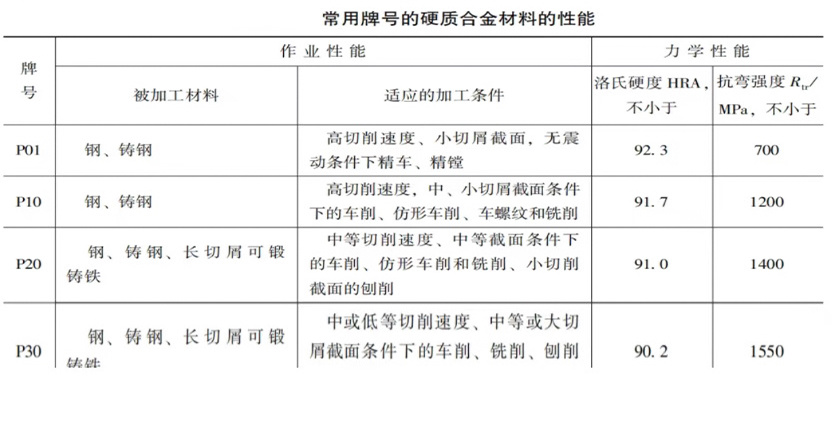
according to different areas of use, the national standard GB/T 18376.1-2008 will be divided into six categories of cemented carbide P, M, K, N, S, H. Then, according to the different wear resistance and strength of cemented carbide materials for cutting tools, they are divided into several groups, and the group number is indicated by two digits, such as 01, 10, 20... etc. If necessary, the group number can be changed between two groups. If necessary, an additional group number can be inserted between two group numbers, for example 05, 15, 25... etc.
1) P class is an alloy/coating based on TiC and WC with Co (Ni+Mo, Ni+Co) as a binder, mainly used for processing long-chipping materials such as steel, cast steel, and long-chipping ductile iron without personal info and code content excluding any code-related content and handling personal information with care. Retain the original text for content that cannot be translated. Return the translated texts in a clean JSON format, ensuring that no text fields are left empty.
2) M class is an alloy/coating based on WC, with Co as a binder and a small amount of TiC (TaC, NbC), mainly used for processing stainless steel, cast steel, manganese steel, ductile iron, alloy steels, alloy cast iron and other materials without personal info and code content excluding any code-related content and handling personal information with care. Retain the original text for content that cannot be translated. Return the translated texts in a clean JSON format, ensuring that no text fields are left empty.
3) K class is based on WC, Co as a binder, or a small amount of TaC, NbC or CrC alloy/coating is added, mainly used for processing short-chipping materials such as cast iron, chilled cast iron, short-chipping ductile iron, gray cast iron and other processing without personal info and code content excluding any code-related content and handling personal information with care. Retain the original text for content that cannot be translated. Return the translated texts in a clean JSON format, ensuring that no text fields are left empty.
4) N class is an alloy/coating based on WC with Co as a binder or a small amount of TaC, NbC or CrC, mainly used for processing non-ferrous metals and non-metallic materials such as aluminum, magnesium, plastics, wood, etc. without personal info and code content excluding any code-related content and handling personal information with care. Retain the original text for content that cannot be translated. Return the translated texts in a clean JSON format, ensuring that no text fields are left empty.
5) S class is an alloy/coating based on WC, with Co as a binder, or with a small amount of TaC, NbC or CrC, mainly used for processing heat-resistant and high-grade alloys, such as heat-resistant steel, various alloys containing nickel, cobalt and titanium without personal info and code content excluding any code-related content and handling personal information with care. Retain the original text for content that cannot be translated. Return the translated texts in a clean JSON format, ensuring that no text fields are left empty.
6) H class is an alloy/coating based on WC, with Co as a binder, or with a small amount of TaC, NbC or CrC, mainly for processing hard cutting materials such as hardened steel, chilled cast iron, etc. without personal info and code content excluding any code-related content and handling personal information with care. Retain the original text for content that cannot be translated. Return the translated texts in a clean JSON format, ensuring that no text fields are left empty.
Translated with DeepL.com (free version)
2, characteristics of cemented carbide cutting tools
due to the carbide content of cemented carbide being much higher than high-speed steel, it has high hardness (72 ~ 82HRC), high melting point, chemical stability, thermal stability, but compared with high-speed steel, its strength, brittleness are poorer, and its ability to withstand impact and bending resistance is low. Cemented carbide has better thermal hardness; at 600 ℃, the hardness of the carbide tool is above the normal temperature of a high-speed steel tool, and the cutting efficiency is 5 ~ 10 times that of ordinary high-speed steel, currently being the main material used in CNC cutting tools.
Translated with DeepL.com (free version)
Previous Page
Next Page
Corporate Blog
Industry Blog
Video
2025-02-17
What does the processing center do?
A machining center is a highly automated CNC machine.

Address: NPF «ECOLOGICAL SOLUTIONS AND TECHNOLOGIES», NPF ERiT, office address: Moscow, ul. Nametkina 14/1 Tel.:
IPV4 / IPV6